Last updated: August 12, 2026
- – A $20 to $50 monthly cut from one recurring expense can create the first savings cushion.
- If you are paid biweekly, even a $10 split becomes $260 a year .
- Key Facts – A $5 or $10 transfer every payday is a realistic starter target for many low-income households.
- On a tight budget, a successful $5 or $10 transfer repeated every payday beats a bigger plan you quit after one week.
Quick Answer: For most households, the quickest realistic way to start saving on a low income is a $5 to $10 automatic transfer on payday plus one expense cut that saves $20 to $50 a month. That is the core of fast saving tactics low income — complete guide; it works because the amount is small enough to survive a tight week.
When money vanishes before you can tuck any away, the fix is not “just spend less.” Not really. Use fast saving tactics that fit a tight income instead: tiny automatic transfers, same-day cash traps, bill-timing fixes, and a short list of cuts that do not wreck your life. I write about personal finance with a focus on low-income households, and the first thing I tell people is simple: saving starts with stopping the leak, not with pretending you live like someone else. For fast saving tactics low income — complete guide, the goal is a small buffer, not a perfect budget.
Key Facts
– A $5 or $10 transfer every payday is a realistic starter target for many low-income households.
– A $20 to $50 monthly cut from one recurring expense can create the first savings cushion.
– A separate savings account or bucket helps keep money out of everyday spending.
– Cash envelopes work best for one or two problem categories, not for every expense.
– Should a transfer cause an overdraft, the tactic is too aggressive and should be scaled back.
– The Consumer Financial Protection Bureau says small emergency savings can help households avoid costly borrowing.
Saving on a low income is hard for one plain reason. Your budget has fewer mistakes built into it. One surprise fee, one medicine refill, one shift cut, and the month can fall apart. So the aim is not to become “good with money” in the abstract. It is to build a small, repeatable buffer fast enough that the next emergency does not force a payday loan, overdraft, or credit card spiral. According to the Consumer Financial Protection Bureau, even a small cash cushion can reduce financial stress. Fragile budgets snap like dry twigs.
Fast Saving Tactics for Low Income: What Actually Works First
Usually, the fastest way to save on a low income is to treat saving like damage control, not like a long-term investing plan. I would begin with three moves in this order: separate the money, cut one high-friction expense, and create one automatic transfer on payday. That order matters because it matches the way tight budgets fail.
Put savings somewhere hard to touch first. A separate savings account at a bank or credit union is enough for most people. If your bank makes transfers annoying, that friction helps; if the account is too easy to move money from, it turns into a parking spot for spending money. A credit union or local bank can be a good place to look if fees are a problem.
Pick one leak you can stop this week next. The usual suspects are overdraft fees, late fees, app subscriptions, delivery orders, convenience-store runs, and “small” impulse purchases that repeat. On a low income, the issue is rarely one giant luxury. It is a handful of tiny decisions that pile up fast. The FDIC notes that lower-fee account choices can matter when balances are small.
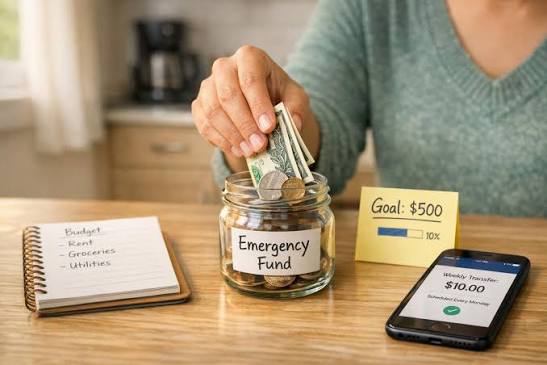
Set an automatic transfer for payday, even if it is tiny. I mean small enough that it does not make the next grocery trip fail. On a tight budget, a successful $5 or $10 transfer repeated every payday beats a bigger plan you quit after one week. If you are paid every two weeks, that is only $130 to $260 a year, but it can still create the first emergency cushion.
People often get the usual advice wrong. They assume saving has to wait until debt is gone or income rises. That is a trap. You need a starter cushion before everything else feels possible. Even a small buffer can keep a flat tire from turning into a crisis.
Trade-off? Clear as day. These tactics do not build a large emergency fund overnight. They build momentum. That is the point.
Fast Saving Tactics for Low Income: The Real Difference Between “Cutting Back” and “Redirecting Cash”

I think “cut back” is the wrong mental model for many low-income savers. Redirecting cash wins because it focuses on timing and structure, not willpower. Cutting back says, “spend less forever.” Redirecting cash says, “move money out of the spending path before it can vanish.”
That distinction matters when income is irregular. If you earn by the hour, get tips, pick up shifts, or receive benefits on a schedule, the problem is not just total spending. It is cash-flow timing. You can be solvent on paper and still be broke on Thursday. Redirecting cash fixes the first hour after payday, which is exactly when most plans fall apart.
The strongest redirection tactics are:
- splitting direct deposit if your employer allows it
- moving even a small amount to savings the day income arrives
- paying fixed bills right after payday so the spending remainder is visible
- keeping “extra” money in a different account or place from checking
- using round-up savings only if it does not cause overdrafts
Cutting back still matters, but it works best on recurring waste, not on every purchase. Say you buy the same snack, drink, or ride share every week. Stop that habit and you can create the first savings cushion. What I would not do is build a plan that depends on never buying anything enjoyable again. That tends to blow up the moment stress spikes.
Here is the cleanest distinction: cutting back is about less; redirecting is about earlier. On a low income, earlier is usually better.
The downside of redirection is that it can feel like nothing is changing because you do not “see” the saved cash in your main account. Fair enough. That is a feature, not a bug. If the money is visible, it is spendable.
Fast Saving Tactics for Low Income: Direct Deposit Splits, Sub-Savings, and Cash Envelopes
This is where I would put my effort if I had to help someone build savings fast without asking them to become a monk. Direct deposit splits, sub-savings buckets, and cash envelopes solve different problems, and the right one depends on how you spend.
Direct deposit split wins for people with stable paychecks and a bank that supports it. Part of your paycheck goes straight to savings before checking ever sees it. That is the cleanest setup because it removes the decision point. The drawback is that it can be hard to adjust quickly if your income changes from week to week. If you are paid biweekly, even a $10 split becomes $260 a year.
Sub-savings buckets inside one bank account work for people who need structure but still want easy access. You can name buckets for rent backup, car repairs, school costs, or groceries. The strength here is clarity: money feels less tempting when it has a job. The weakness is obvious — if the account is too easy to tap, some people will still move the money back.
Cash envelopes win for people who overspend in one or two categories and need a hard stop. Groceries, transit, and personal spending are common candidates. I would use envelopes when card spending becomes slippery. The downside is practical: cash can be lost, stolen, or simply inconvenient. It also does not work well if your area is cashless or if you pay many bills online. Sometimes it is a blunt tool, but blunt tools can be useful.
For low-income saving, I like a hybrid approach: direct deposit split for the first small amount, then one or two cash envelopes for the categories that regularly go off the rails. That combination gives you structure without demanding perfect self-control.
A generic article would tell you to “budget better.” Too vague. What matters is choosing a system that makes bad spending harder and good saving automatic.
Fast Saving Tactics for Low Income: Who Should Actually Use Cash Envelopes, and Who Shouldn’t
Cash envelopes are the right tool for people who know exactly where their money leaks. If you routinely lose control with groceries, fast food, rides, or little impulse buys, envelopes win because they create a stop sign you can feel. You can only spend what you pulled out. That limit is the point.
They also help if you live on variable income. When you do not know what the week will bring, a set amount of physical cash can make the next decision simpler. You do not have to wonder whether the card swipe will push you into overdraft. You already know what the category has left.
But I would not recommend envelopes for every low-income saver. Skip them if:
- you pay most bills online and cannot easily use cash
- you travel a lot or face a real risk of losing cash
- your income is so unstable that the envelope system creates panic
- you are already juggling too many accounts and need simplicity, not more steps
The biggest weakness is that envelopes are a tool, not a solution. They do not raise income. They do not fix rent that is too high. They do not make a car repair vanish. If your problem is structural—too little income, too much debt, or a benefit cliff—envelopes help only at the margins. Think of them as a speed bump, not a new road.
Still, for people who need a fast stop to small daily leaks, envelopes are one of the most honest methods around. They are visible. They are blunt. They work because they remove choice.
If you use them, choose one or two categories only. Too many envelopes become a part-time job.
Fast Saving Tactics for Low Income: The Specific Situations Where Automatic Transfers Win
Automatic transfers win when your money disappears because your attention gets pulled somewhere else. If you are busy, tired, working multiple jobs, caring for kids, or simply burned out, automation is better than motivation. It saves money on the day you are least likely to care about saving.
The best use case is often a paycheck that arrives on a predictable schedule, because then the transfer can be timed with less risk of an overdraft. In that setup, I would set a transfer for the same day or the next business day after payday. The point is to remove the “I’ll move it later” lie. Later often becomes never.
Automation also works well for people rebuilding after debt or overdrafts. A small automatic transfer creates a visible win without much decision fatigue. That matters because low-income budgeting fails fastest when the system feels emotionally heavy. A tiny automated habit can make saving feel normal again. The CFPB recommends building savings gradually rather than waiting for a perfect month.
The weakness is just as real: automation can backfire if your account balance gets too thin and fees follow. If a transfer causes an overdraft or forces a bill to bounce, it is not helping. On a tight budget, failed automation can be worse than no automation because it adds fees and discouragement.
This is why I prefer “micro-automation.” Start smaller than you think you should. If your margin is only a few dollars, protect the checking account first. Saving that survives is better than saving that triggers penalties.
One more thing most articles skip: if you get paid irregularly, automate only after your fixed bills are covered. Otherwise you may save money from the wrong week and create a shortfall you cannot absorb.
Automation is not glamorous. It works because it asks less from you.
The Honest Side-by-Side
Below is the comparison I would use if I had to choose the fastest saving tactic for a low-income household that needs something practical, not perfect.
| Criteria | Automatic transfers | Cash envelopes | Winner for [condition] |
|---|---|---|---|
| Speed to start | Very fast if your bank allows simple scheduling | Fast, but only after you withdraw and sort cash | Automatic transfers for people who want the easiest setup |
| Protection from impulse spending | Moderate; money can still be moved back | Strong; cash is physically limited | Cash envelopes for people who overspend in one category |
| Risk of fees | Higher if the account balance is too thin | Lower bank fee risk, but cash can be lost or stolen | Cash envelopes for people who get hit by overdrafts |
| Works with irregular income | Only if transfers are kept very small and timed carefully | Often easier to adapt week by week | Cash envelopes for hourly workers with variable pay |
| Best for recurring bills | Strong when paired with payday timing | Poor for online and fixed bills | Automatic transfers for bill-heavy households |
| Ease of tracking | Easy on a banking app | Very visible, but requires manual counting | Automatic transfers for people who want less admin |
| Emotional friction | Low once set up | Can feel restrictive or embarrassing for some people | Automatic transfers for low-friction saving |
| Best first save | Starter emergency fund | Problem category control | Depends on whether the issue is access or overspending |
| Long-term sustainability | High if income is stable enough | High if spending leaks are the main problem | Tie, but only for the right user |
The table tells the real story: automatic transfers are better for building a small buffer with less effort, while cash envelopes are better for stopping one stubborn spending problem. The common mistake is to ask which one is “best” in general. They solve different failures.
If your main problem is forgetting to save, automation usually wins. If your main problem is overspending after you handle money, envelopes win. If both are true, use both in a simple version.
Our Verdict: Which One to Choose and Why
Choose automatic transfers if your income is regular enough that a tiny scheduled move will not trigger fees, and you want the fastest path to a starter emergency fund. Choose cash envelopes if you know exactly where your money leaks and you need a hard physical limit to stop that habit. Neither if your rent, utilities, or debt payments already exceed what your income can reliably cover; in that case, the real fix is a deeper budget reset, lower housing cost, debt counseling, or income support.
That is my call because low-income saving is mostly about preventing the next failure. Automation can prevent forgetfulness, but if that is not your main issue, another tool may fit better. Envelopes prevent impulse spending. If you are trying to save your first small cushion, automation is the better default. It asks less of you and keeps the process moving. If you need help finding a nonprofit counselor, the National Foundation for Credit Counseling is one place to start.
I would choose envelopes over automation when a single spending category is the reason you never have money left. Groceries are a common example, but so are food delivery, gas, snacks, rides, or weekend spending. In those cases, a physical limit changes behavior faster than a spreadsheet ever will.
The most honest recommendation I can give is this: if you are starting from zero and feel overwhelmed, set one tiny automatic transfer and one hard-spending envelope. Keep both small enough that you do not sabotage rent or food. That combination gives you momentum and control without pretending your budget is larger than it is.
When to Reconsider This Choice Entirely
The whole saving plan flips when the problem is not spending behavior but math. If your basic bills cannot be covered with your current income, no savings tactic will fix that by itself. You may need to ask for more hours, look for a second job, renegotiate a bill, apply for benefits, move to a cheaper place, or get help from a nonprofit credit counselor. The USA.gov benefits page can help you find support options.
The verdict also changes if overdrafts or bank fees are already eating your balance. In that case, automatic transfers may be too risky until you stabilize the account. Use a very small transfer only after you know the timing will not create a fee chain.
Another flip point is debt with high interest and a minimum payment you are struggling to meet. If missing payments is your main danger, I would prioritize keeping accounts current before building larger savings. A tiny emergency cushion still matters, but not at the cost of delinquency.
Finally, reconsider the whole approach if your household has shared finances and no one agrees on the rules. Saving tactics fail fast when one person is trying to build a buffer and another is draining it. In that situation, the first task is not the savings tool. It is making the money system visible and agreed upon.
Fast Saving Tactics for Low Income: What a Generic Article Misses
Generic advice usually assumes you have three things low-income readers often do not have: stable pay, a spare margin, and a calm week to make “smart choices.” That is why it misses the point.
What matters more is sequence. First, stop fees. Second, stop the leaks you can feel. Third, automate a tiny amount. Fourth, protect it in a separate place. Only after that does it make sense to chase bigger goals.
A generic article also tends to romanticize discipline. I do not. On a low income, discipline is expensive. It takes energy you may need for work, childcare, transit, or health problems. A good saving tactic should reduce decisions, not add them.
Here are the fast tactics I would prioritize in real life:
- Open a separate savings account or bucket. Keep it out of your normal spending flow.
- Move a tiny amount on payday. Small is fine; consistent is better.
- Attack one leak. One subscription, one fee, one expensive habit.
- **